Customer Relationship Management Platforms for Consulting Firms: A Buyers Guide


Relationships are the lifeblood of your organization, and you need the right tools to help build and sustain long-lasting business relationships that generate repeat business and open doors for new opportunities. Unfortunately, many of the tools used to manage these essential connections are ill-suited to the task and to the specific needs of consulting firms.
Consulting is about long-term relationships, not sales transactions.
Leading firms are adopting new technologies that help consultants manage their prospects and customers as relationships rather than sales transactions. The best tools simultaneously free them from manual information management, give them confidence in their data, and allow them to leverage that data to gain new insight into those relationships.
Read on to learn about the most valuable innovations in modern customer relationship management technology and how they can make your team more efficient, improve collaboration among team members, help you stay on top of your most important business relationships, and close more deals faster.
Relationship-management tools for your relationship-oriented business
Your firm is dedicated to delivering high-value, strategic products and services—advisement on anything from new technologies to company culture to change management.
To deliver for your clients while simultaneously pursuing prospective business, you need high-value, strategic tools for the business development process.
But even at firms that consult on complex technical problems, the tech stack that supports customer relationship management (CRM) has often not kept pace. For the majority of consulting firms, many CRM processes and tools look the same today as they have for decades.
These traditional platforms are built to help sales organizations manage transactional relationships with customers and prospects—one-off deals or annualized contracts that are tracked in a straight line from prospect to close.
Once the ink is dry, that prospect is handed off to a customer success or development team, and the sales team moves on.
Your firm, on the other hand, needs a relationship-focused solution that allows you to collaborate and work with clients efficiently—and leverage your relationship with them to generate new business—from before a project begins, throughout a project’s duration, and long after any individual project is complete.
A CRM is more than just another tool in your technology toolbox: it’s the foundation for every deal your firm pursues, every relationship in your organization’s network, and every opportunity in your business’s future.
5 common problems with transactional CRM platforms
- Inconsistent data storage
- Routinely out-of-date data
- Lack of coordination and collaboration
- Inability to review and optimize processes
- Low adoption rates due to poor usability
Traditional CRM platforms are not the solution
Sales-focused CRMs like Salesforce are quantitative and transactional, built to facilitate moving a sale from prospect to customer. Let’s look at some common problems professional services teams face when relying on transactional CRM platforms:
1. Inconsistent data storage. When individual team members store data locally, valuable information gets lost among scattered sources. Centralization is a key step toward unifying your team’s data management processes and creating an easily accessible single source of truth.
2. Routinely out-of-date data. Manual data entry is tedious. No one wants to come back from a client dinner and enter data into their CRM, but doing so is necessary to keep records up to date and information current.
3. Lack of coordination and collaboration. Disparate data sources may lead team members to take action without knowing about other, parallel efforts. Efficient knowledge-sharing helps your team move in harmony so they can do complementary—rather than overlapping—work.
4. Inability to review and optimize processes. Without a comprehensive record of past performance, it’s difficult to make accurate predictions or team-wide improvements. Your team has to be able to iterate and improve in order to close fast-moving deals before the competition.
5. Low adoption rates due to poor usability. Cumbersome user interfaces discourage teams from using their CRM. The ideal system should have an easy-to-use interface that creates a simple system supported by sophisticated underlying technology.
Whether you’re already using a CRM or you’re using spreadsheets and notepads to manage the data that drives your deal-making, it’s likely that many of the issues above feel familiar.
6 key features to look for in a CRM platform
- Launch quickly
- Increase adoption
- Automate data capture
- Find the right connections
- Stay on top of relationships
- Improve client management
The advantages of a CRM purpose-built for relationship-driven businesses
Your firm is not just marketing and selling a product; you’re building hundreds or even thousands of unique relationships in pursuit of new business. Relationship-oriented platforms track and manage your deals while also helping to maintain those relationships over the lifetime of your business.
By automating data capture and analyzing data sets, your technology should free your team to focus on work that machines can’t do: putting relationships at the forefront of customer relationship management and closing more deals.
Here are the key features and capabilities consulting firms should look for in a CRM platform:
1. Launch quickly. Traditional CRMs can take months to integrate before they are fully functional. A purpose-built, lightweight CRM system is designed with a precise set of tools that map to your unique needs without the bloat of bulky enterprise systems, so they can be up and running much faster.
2. Increase adoption. The platform’s most valuable tools should all be easy to navigate and intuitive to use. A great user experience ensures every member of your firm actually wants to use the CRM you invest in.
3. Automate data capture. The “data exhaust” of your daily business communications—details pulled from email communications, meetings, and contact information such as names, roles, industry, and source of introduction—should be recorded in your CRM automatically, so your records are always current and comprehensive.
4. Find the right connections. Relationship insights should build on this data so your team knows the details of your business network at a glance.
5. Stay on top of valuable relationships. A platform should provide tools that help you follow up to close out an outstanding proposal or move in to close a new deal.
6. Collaborate on projects and improve client management. Instant visibility into every relationship your team has and every project your team is managing means your team will always be tightly aligned.
All of these elements combine to create a platform focused on efficiently building your book of business and tracking and closing deals as easily as possible. Unifying these technical improvements on a single platform yields relationship intelligence.
What is relationship intelligence—and why is it essential to your CRM?
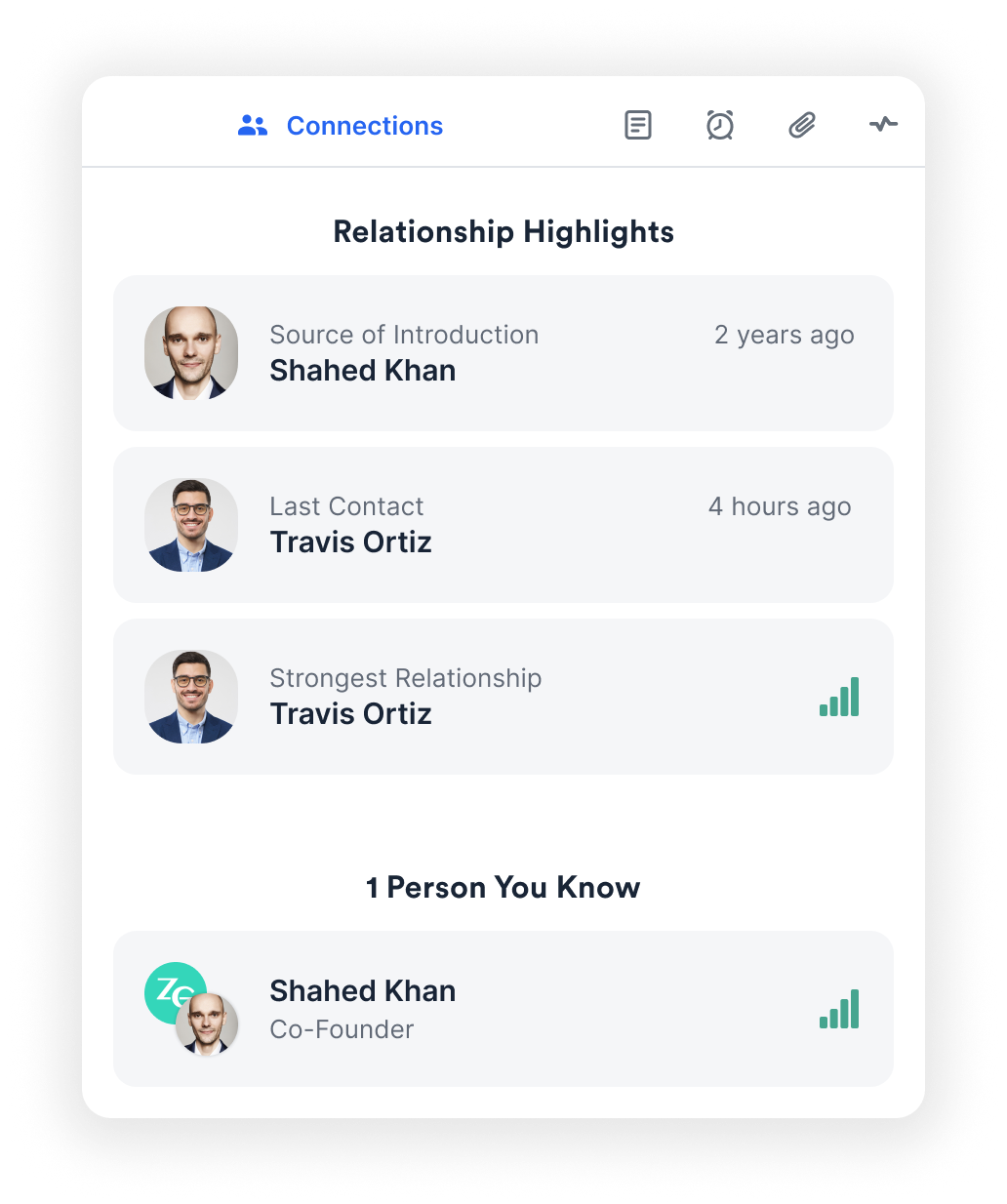
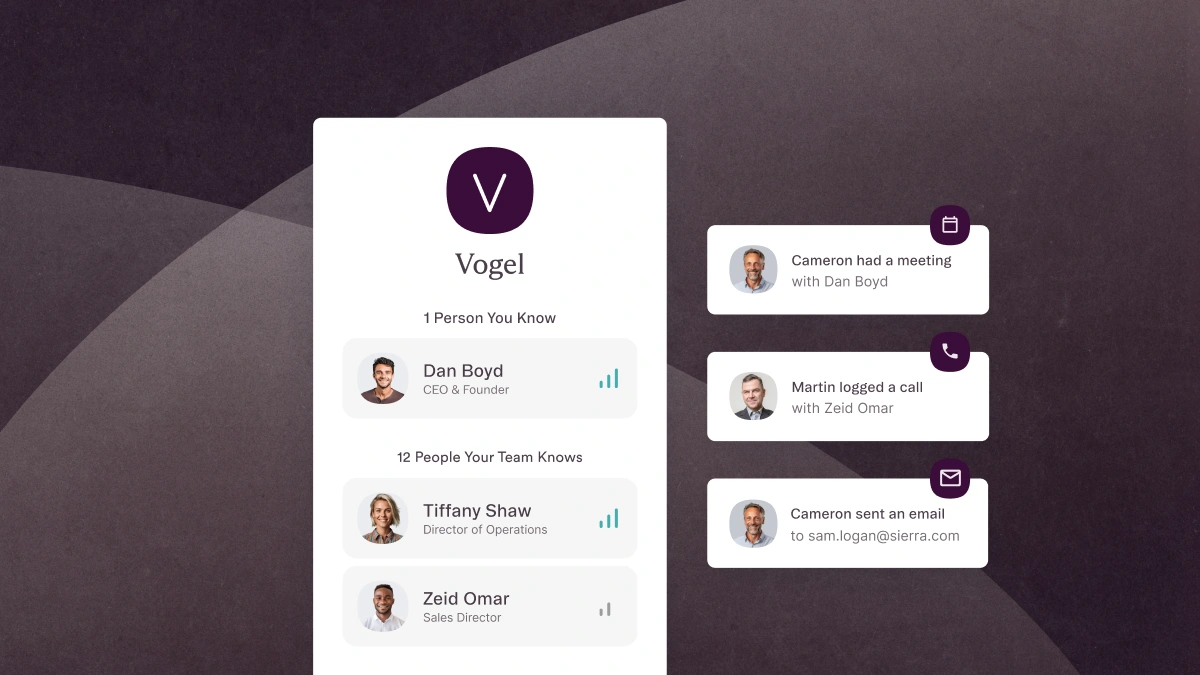
Relationship intelligence is the insight into your team’s network, business relationships, and customer interactions that help you find, manage, and close deals.
These insights are generated by AI-driven algorithms that analyze data from every email, meeting, and interaction between your organizations and every business contact you’ve engaged with, and enriches it with data from relevant third-party sources.
The “intelligence” includes things like who has the best relationship to a contact who can advance a deal, whether anyone on your team knows anyone at a target organization, and whether that organization has new hires with whom your firm can build new relationships.
Relationship intelligence puts the momentum behind your deal-making—and it underlies the difference between transactional sales and doing business successfully in the nonlinear way that consultants work.
What to look for in a consulting CRM
Whether you want to replace your existing CRM or you’re shopping for your very first one, use this checklist to keep track of the key features separating traditional CRM platforms from a CRM built for consulting and other relationship-driven industries:
- Efficient deployment and reliable support
- Intuitive, user-oriented design
- Streamlined contact and opportunity management
- Automated activity tracking
- Comprehensive analytics
- Straightforward scalability
- Applied relationship intelligence
Efficient deployment and reliable support
The timeline from purchase to deployment will always vary based on the size of your organization, the volume of data in your existing system of record, and the capacity of your CRM vendor.
The average CRM implementation period is about ninety days, but the integration may go longer if a lot of customization is required.
Long deployment periods increase your time-to-value on an already imperfect system, which means your organization is spending time, money, and resources at launch and again down the line if the platform doesn’t properly map to your team’s needs.
Some CRMs require long-term implementation partners, and managing these partners adds cost and can lengthen deployment time to customize a rigid system with features your team may or may not need or use.
A lightweight, purpose-built system can be up and running in a matter of days.
And the best systems come with a reliable, accessible, knowledgeable—and even proactive—support team.
Intuitive, user-oriented design
The two most commonly used CRM solutions for consulting teams are traditional CRM software platforms built on cumbersome, enterprise-scale technologies, and spreadsheets that are familiar but provide little of the functionality you require.
Combining savvy user experience design with the flexibility of a relationship-oriented CRM means your team has an easy-to-use workflow tool that allows you to manage complex, constantly evolving deals easily.
Software that is intuitive, elegant, and user-oriented will be much easier to get your team to use.
Streamlined contact and opportunity management
The most popular reason teams implement a CRM is to increase efficiency. But a CRM becomes a hindrance to productivity when your team has to manage it manually.
When it comes to relationship data entry, hundreds of emails and calls can turn into hundreds of hours of logging them into a CRM or, worse yet, entering them on a spreadsheet. Managing your active opportunity pipeline across disparate spreadsheets and email inboxes leads to double work, siloed records, and missed opportunities.
Freeing your team from manual data entry by automating data capture from emails, phone calls, and calendar events—and creating a centralized and comprehensive repository in which to store it—yields more time to cultivate meaningful relationships and close more business. It also ensures your contact data is current and clear.
It also preserves business continuity: when a member of your team leaves, their business activity is accurately preserved, so you can continue where they left off.
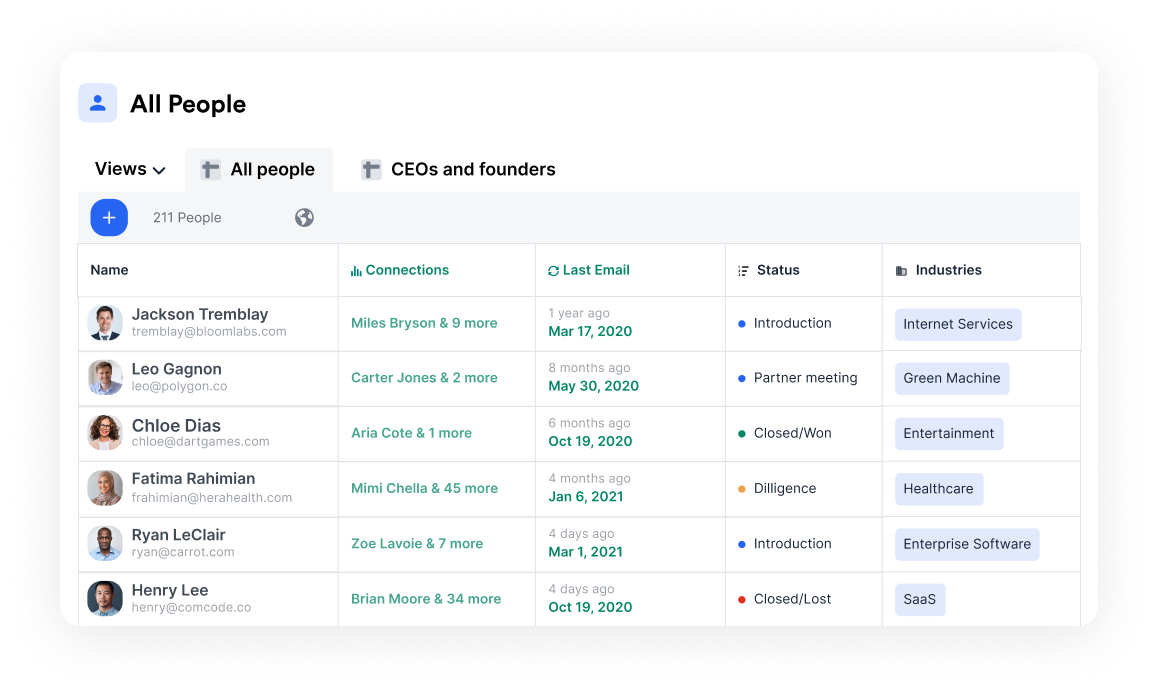
Consulting CRMs should also provide a way to manage every deal collaboratively, creating visibility into how new opportunities are progressing. Transparency into your pipelines lets you ask focused questions about project status or prospects and remove any blockers.
Automated activity tracking
Your firm’s CRM is only as good as the data recorded in it.
Automated activity tracking ensures that you have a record of every email, every call, and every meeting with a contact, and forms a deep reservoir of reliable data. Centralized activity records consolidate these communications so you can follow up efficiently.
Easy-to-understand visualizations of activity timelines depict exactly who reached out to a connection and when, so anyone can follow up. Additionally, by capturing files directly alongside relevant communications, you can track and take action on specific business development activities like reviewing when an RFP was sent.
Scheduling and communications alerts become reminders to check a deal’s status, follow up with a prospect, or reach out to a colleague.
Comprehensive analytics
Using the data captured by your CRM also enables you to review historical performance and current pipeline activity, understand how your team is spending its resources, and monitor relationship touchpoints. Analytics and reporting tools can create customizable dashboard views of your projects and deal pipelines.
If your division’s information is tracked separately from that of a parent organization, this unified interface can be shared with other teams, eliminating parent-child data silos and ensuring you’re hitting KPIs and working toward the same goals.
You need to identify inefficiencies in your deal pipeline and evaluate your team’s performance.
Built-in analytics enable your team to make faster, more accurate data-based decisions.

Straightforward scalability
If all goes well, your team’s relationship network today is the smallest it will ever be, and the volume of data you’re tracking will grow exponentially as your team gets bigger. Your CRM should be able to keep pace easily and affordably.
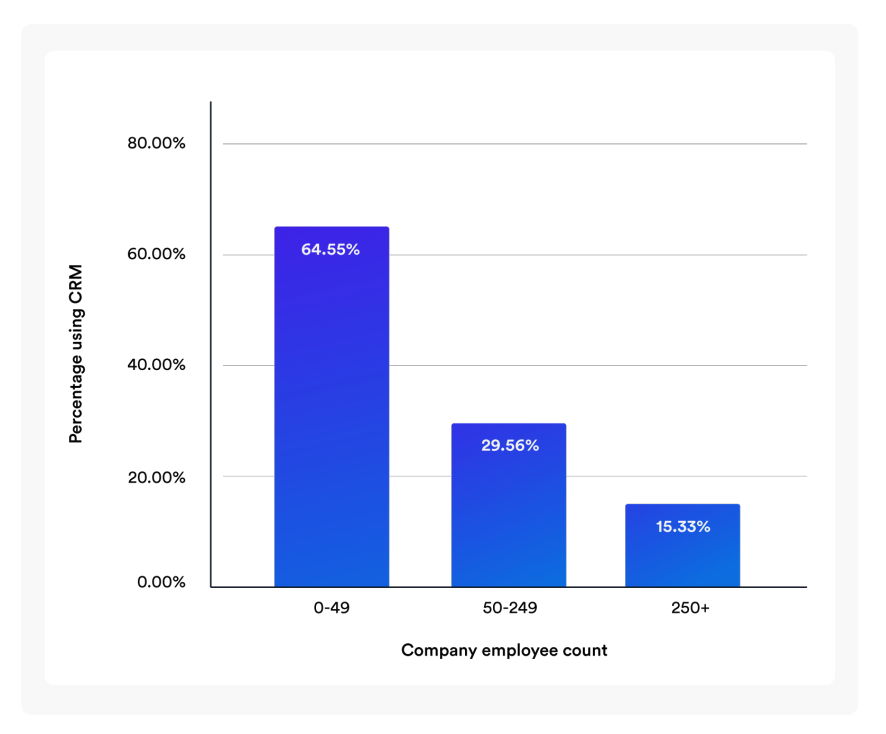
But growing firms that rely on traditional, manual CRM platforms find they have a new problem as they add seats: more and more data falls through the cracks. As companies grow and systems become more complex, fewer and fewer employees use their CRM.
Prevent the loss of your company's relationship data.
By relying on the automated data capture of a CRM that scales elegantly along with your business, you can prevent the loss of up to 85% of your company’s relationship network data.
CRM software for consulting firms should also be designed to get new team members onboarded quickly. The user-oriented design of a good consulting CRM means that new hires can easily navigate the platform, reducing training costs and getting your business development team up to speed quickly.
Applied relationship intelligence
Relationship intelligence elevates your CRM from a system of record to a platform that provides unique insights into your team’s collective business networks.These insights are the foundation that separates transactional CRMs from relationship-focused platforms.
Quantifying relationship strength can take the guesswork out of your business development team’s outreach efforts. And data enrichment further expands your team’s knowledge by providing insights from third-party partners to further contextualize every relationship in your network.
With these additional insights, you can source new deals based on more accurate, comprehensive records. You can also unearth previously undiscovered opportunities, surfacing new introduction paths that would otherwise be hidden away in individual spreadsheets or an under-utilized CRM.
Using a CRM supported by relationship intelligence gives you the edge in your deal-making and new business development.
With comprehensive relationship data at your fingertips, you can create new opportunities while continuing to grow your business with existing clients by understanding not only who knows whom, but also how well they know each other.
The Affinity advantage
Have the confidence to collaborate
Consulting is driven by the connections between your team and the deals that define your firm. Affinity’sRelationship Intelligence CRM is purpose-built for consulting organizations and enables your business development teams and partners to leverage their personal networks to find, manage, and close deals faster—all with software that every team member will find easy to use.
No more manual data entry
Affinity is able to extract historical data from your existing system and can be up and running quickly—often in only a few days. Once you’re onboard, the platform can automatically capture the data exhaust of every relationship you’re managing right alongside active deal pipelines, providing a comprehensive understanding.
Easily manage your business network
Affinity ensures you never lose track of your contacts. Detailed, AI-driven insights provide a thorough understanding of your team’s collective network, quantifying and scoring the quality and depth of those relationships, and moving you beyond knowing only who knows whom. You can even connectAffinity to some of your favorite productivity, marketing automation, and file-sharing tools to further improve the platform’s scope and your work group’s efficiency.
The power of a CRM for consulting firms
Network and opportunity management seems straightforward: track contact information, follow up with your clients, close deals. The reality is that maintaining your team’s vast network of contacts and opportunities can become unruly without clear alignment around consistent, efficient processes.When your business development is supported by Affinity, you can make your team more efficient and provide in-depth insights into every opportunity—so you can connect with confidence, show up smarter, and close your next deal faster.