Deal Flow Management Software
Take control of your pipeline
Manage deals efficiently with deal flow software built for private capital
.webp)








.webp)
Track every aspect of every deal

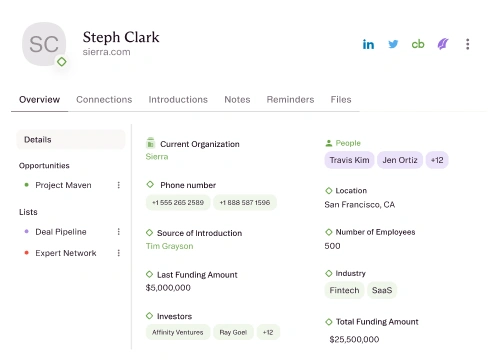
Automatic data and activity capture
Work with accurate, up-to-date deal information

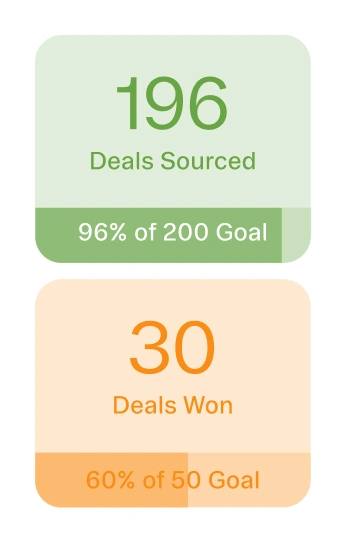
Customizable analytics
Understand where deals come from and why you win

Relationship intelligence
Identify warm introduction paths faster
Act based on the latest deal-relevant data
Monitor deals and make decisions based on accurate data pulled automatically into the CRM. Affinity automates the capture of your firm’s communication activity and enriches each record with data from 40+ trusted sources. Move quickly on the most promising deals and keep your entire team aligned with shared visibility.

Double down on successful strategies
Understand where your most valuable deals come from, how efficient your dealmaking operations are, and who on your team is having the biggest impact. With Affinity Analytics, you can use templates or build custom dashboards to run reports on the metrics that move the needle for your firm.

Get into deals through your network
Turn disparate relationship data into insights that help you access deals. Affinity’s AI-powered relationship intelligence uses recency and frequency of interactions across your collective network to reveal who knows whom and how well. Find your strongest connection for a clear path to new opportunities.
.webp)

"Implementation was really easy. We were able to start using the platform straight away."


"Having a well-defined, clean, golden source data set is more important in the age of AI. That's a lot of the benefit we're seeing from Affinity."


"It's night and day. We are way more organized when it comes to relationships. We've won a good amount of deals we wouldn't have won if we hadn't changed over to Affinity."


"Venture capital is a craft, and Affinity is one of the tools helping the investment team build this craft better."

Explore Affinity
What is relationship intelligence?
Take a closer look at how data powers relationship-driven dealmaking.

Driving firmwide CRM adoption
Explore the ways Affinity supports your firm's investment workflows.
7 tips for optimizing your deal flow
Source more high-quality deals with these recommendations.
Frequently Asked Questions
Dealflow management software tracks investment opportunities from first contact through decision. It holds the company record, the stage, the internal owner, and the interaction history behind each, and reports on how opportunities arrive and convert. The distinction from a sales CRM is the time horizon, and the fact that most opportunities end in a documented pass instead of a close.
Four things, in order of how much they matter. Does activity land in the system on its own, or only when someone types it. Does the data model already fit funds and deals. Can permissions restrict access deal by deal. Can the firm change its own stages and fields later without a services engagement. The first question decides whether the other three ever get tested.
Affinity captures every email and calendar interaction automatically, so last contact, deal owner, and activity history stay current without anyone updating a record. After a meeting, the Data Update Agent drafts the field changes it believes follow from the notes and waits for approval. What the team enters by hand is limited to judgment: stage, thesis fit, and pass reason.
Yes. Firms create their own lists, stages, and custom fields, and change them as process evolves, without consultants. Different funds or strategies can run different structures in the same instance, each with its own permission set, so a credit team and an equity team work separately on shared underlying relationship data.
Affinity reports on pipeline by stage, source, owner, sector, and geography, and tracks conversion and time in stage between them. Because activity capture is automatic, the source attribution reflects how deals actually arrived rather than what someone selected from a dropdown at the time.
The relationship graph is usable on day one, because it builds from email and calendar history the firm already has. Structured pipeline records take longer. Affinity's team handles the import and mapping as part of standard onboarding, and most firms reach full production inside 60 days.
Put your firm’s network to work